Neuropatterns
Working Memory, Auditory Scene Analysis, and Musical Scene Analysis
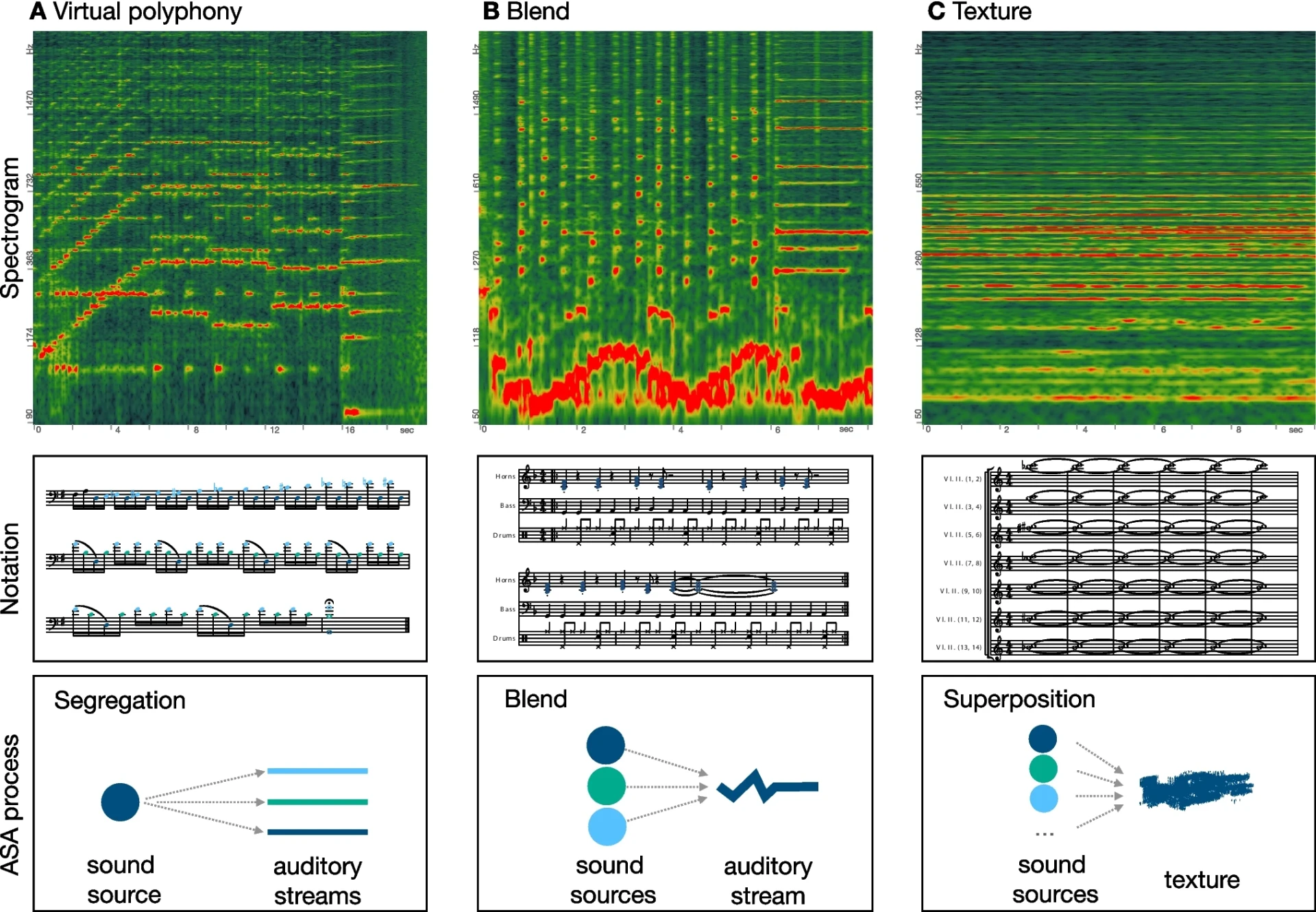
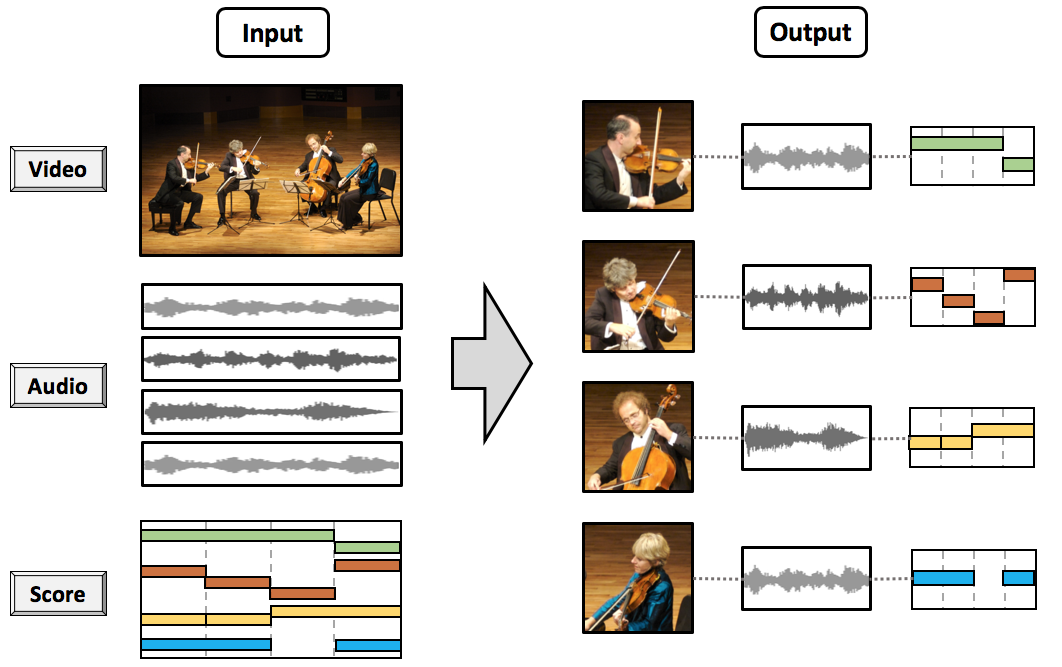
Humans’ unified perception of music relies on the auditory system, which, when processing auditory sounds, simultaneously synthesizes individual musical components into a cohesive musical, rhythmic, or melodic pattern. This process is deeply rooted in Musical Scene Analysis (MSA), a field rooted in Albert Bregman’s Auditory Scene Analysis (ASA), which examines how we identify overlapping sound mixtures. The two modes: synthetic listening, which focuses on the universal, cohesive aspects of music, and analytic listening, which focuses on restricted, local details, allows for listeners to break down and reconstruct the mixtures of sound. The perceptual phenomena on auditory streams, a single sound sequence from a chaotic mixture of sounds, is essential in forming related qualities and memorizing a piece over time. For example, a single instrument may diverge into numerous streams, while multiple instruments may merge into a single stream, even though our mental perceptions may not mirror the physical sounds. The interaction between the primitive (analysis of sound from raw physical data in our ears) and schema-based (analysis of sound through past experiences) processes further ensures that perceived auditory sounds construct our overarching streams, both sharing features such as pitch, volume, and timbre.
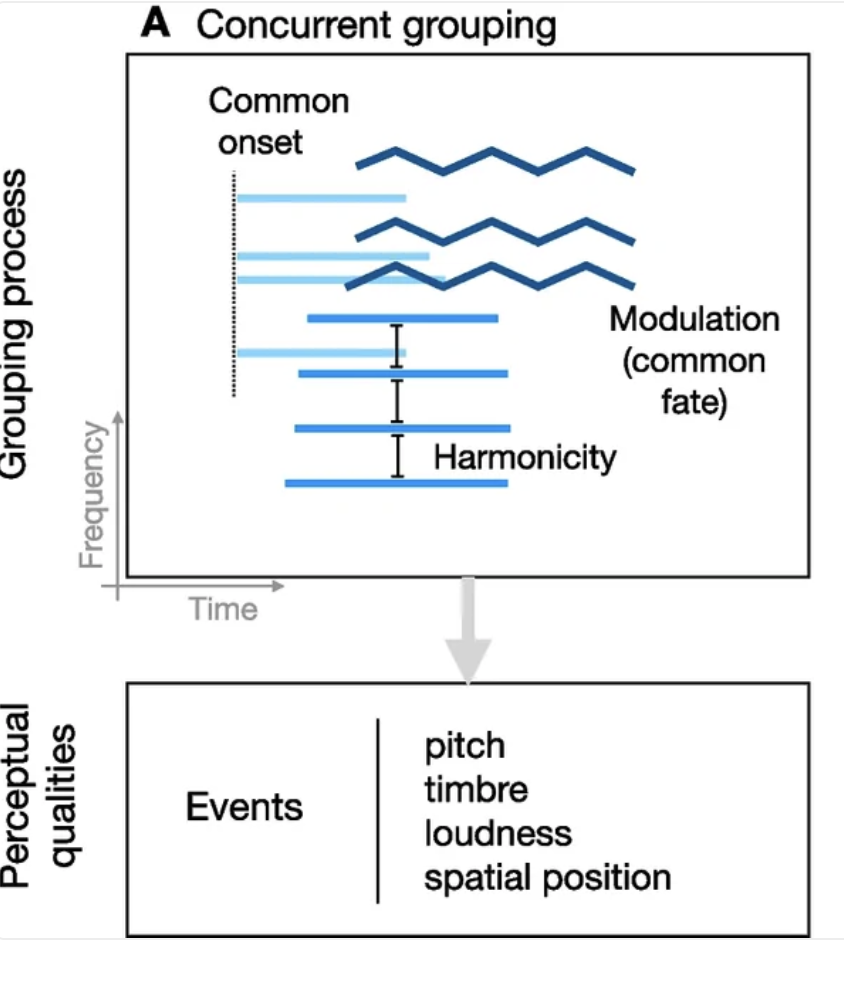
Crucially, the process of concurrent, sequential, and segmental grouping of primitive processes plays a critical role in creating organized representations of overlapping signals. Concurrent grouping serves as a critical mechanism for synthesizing auditory components and segregating them into separate groups based on a specific perceptual feature. When a complex mixture of sounds enters the peripheral auditory system, the brain utilizes three profound cues to categorize each component. First, common onset, which dictates the speed—a few tens of milliseconds—to rapidly categorize musical components into a single perceived pattern. Second, harmonicity, which enables auditory systems to group spaced frequencies together to elicit a perception of a unified pitch. Third, frequency micro-modulation, where components such as vibrato could emerge distinctly from the mixture of sounds.
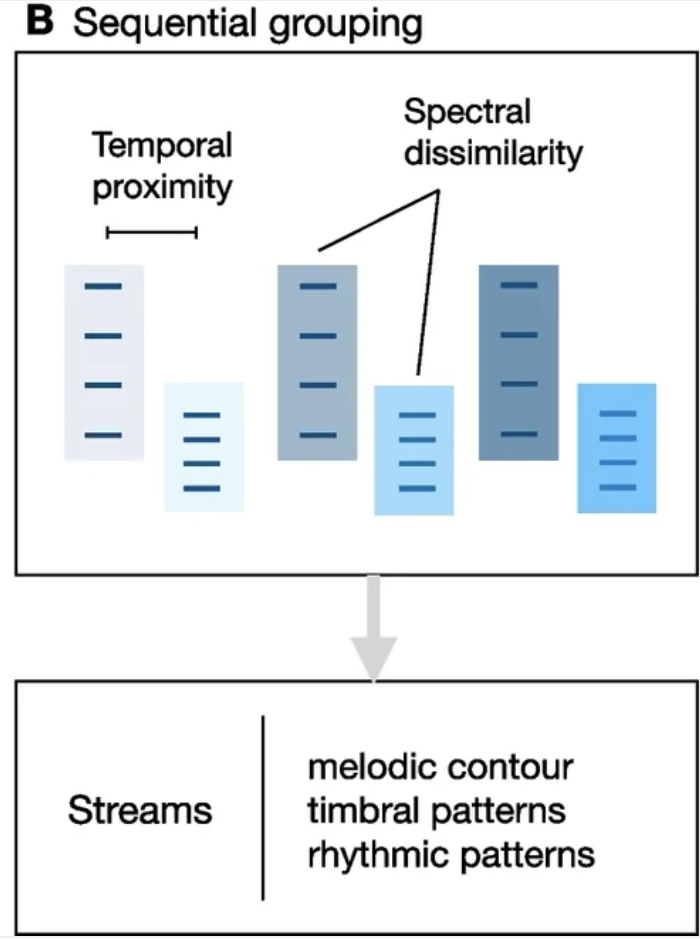
The second crucial stage of MSA shifts to sequential grouping, where the auditory system integrates individual components over time into continuous auditory streams such as a single melody or rhythmic sequence. Based on properties such as frequency proximity, temporal speed, and timbral similarity, the brain constantly determines whether modulating tunes should be categorized into a unified stream or segregated into independent parallel layers through stream segregation.
Finally, segmental grouping plays an essential role in establishing the structural boundaries and in arranging musical structures such as motives, phrases, and themes from chaotic mixtures of sound into a cohesive framework needed for memorizing complex pieces.
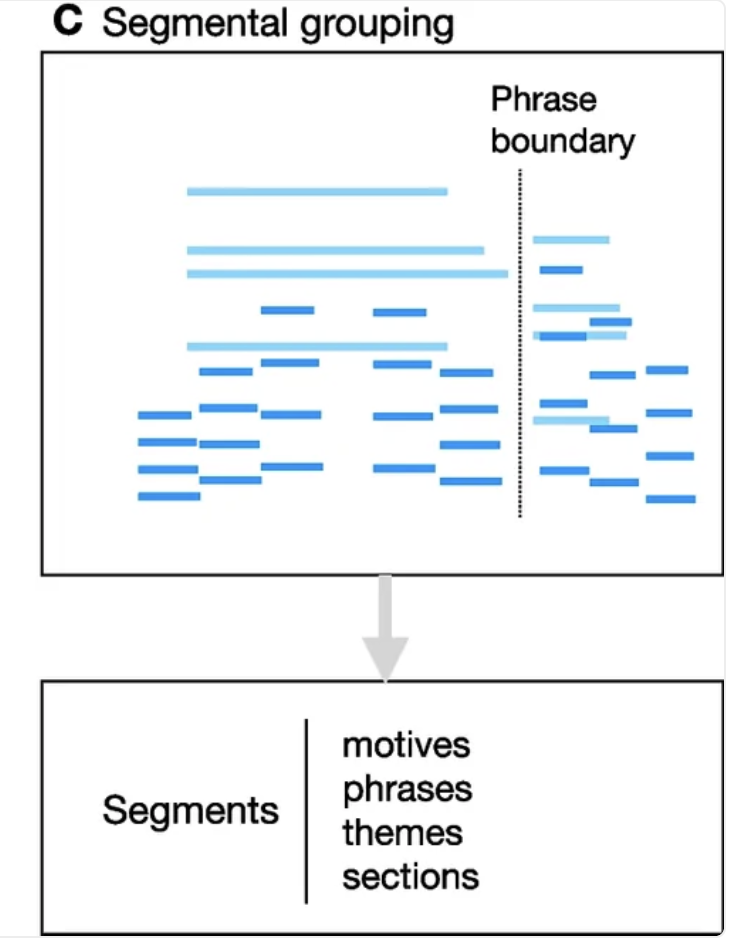
In contrast, schema-based segregation— or top-down processing— occurs when the auditory system uses prior knowledge, expectations, and focused attention to identify complex auditory streams. This process follows directly after primitive segregation, which organizes raw audio into categorized streams, enabling schema-based processes to evaluate the auditory data. By establishing a framework of musical structure and predictability, it not only allows musicians to identify and isolate specific musical characteristics from the complex mixture of sounds, but also to prioritize them in working memory. Ultimately, this cognitive mechanism demonstrates how processes of long-term retention in music are achieved not through rote memorization of each individual note, but through the structural recognition of underlying melodic patterns.
Semantic and Episodic Memory in Music
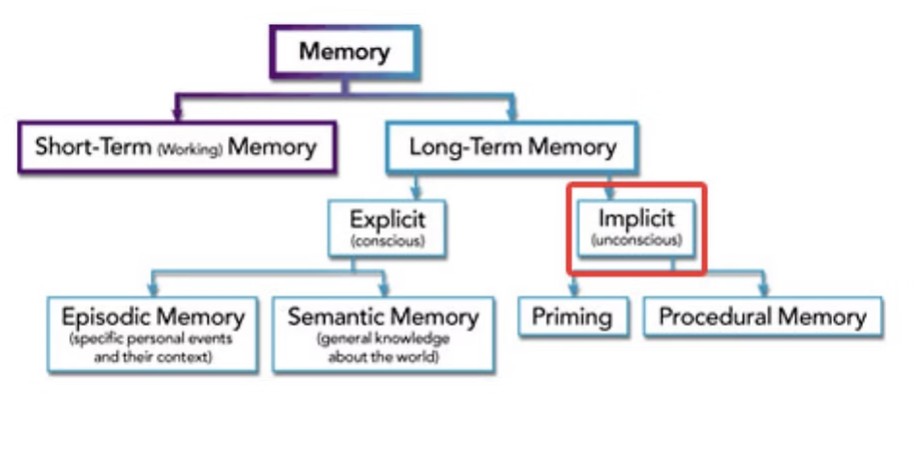
When listening to music, the familiarity of the piece may naturally trigger autobiographical memories. Research reveals an intriguing pattern in how we process information: we are far more probable to name a naming tune we hear than recognize its melody on a page. Conversely, when vocals are introduced, song titles are easier to remember than the underlying melodies, suggesting a fascinating bond between language and sound that is encoded in our perceptual memory system.
This system possesses the ability to store structural information in an abstract form, preserving a listener's recognition of a melody despite alterations in timbre, dynamics, tempo, or pitch register. For complex recognition, however, neuroscientists believe that episodic and semantic memory functions dynamically in active recognition. Episodic memory anchors the piece to a precise time and place in which we previously heard it. In contrast, semantic memory serves as a mechanism for auditory replication, allowing individuals to recall and reconstruct a piece's musical structure when humming or whistling subsequent notes.
Musical Features and Memory Systems
Pitch perception serves as an essential aspect of working memory in music. Rather than audiating the absolute pitch of musical notes, the human brain often internalizes relative pitch variation based on the shifts in distance and direction between notes to facilitate melodic recognition. Through this mechanism, it utilizes perceptual references and the frequency of intervals to transform complex sounds into predictable patterns that enables long-term memory. For trained musicians, the constant practice of sight-reading and music theory allows them to naturally gravitate towards complex cognitive analysis of notational intervals and musical patterns with higher precision, increasing their working memory and capacity to memorize complex musical pieces.
Sources
- "Diagram Showing the Breakdown of Human Memory Systems." DynamicBrain, www.dynamicbrain.ca/implicit-memory.html. Accessed 17 Oct. 2026.
- "Diagrams and Charts Illustrating Musical Scene Analysis." PMC, National Library of Medicine, 2 Aug. 2026, pmc.ncbi.nlm.nih.gov/articles/PMC13429554/figure/Fig1/. Accessed 17 Oct. 2026.
- "Image of Concurrent Grouping." PMC, National Library of Medicine, pmc.ncbi.nlm.nih.gov/articles/PMC13429554/figure/Fig1/. Accessed 17 Oct. 2026.
- "Image of Segmental Grouping." PMC, National Library of Medicine, pmc.ncbi.nlm.nih.gov/articles/PMC13429554/figure/Fig1/. Accessed 17 Oct. 2026.
- "Image of Sequential Grouping." PMC, National Library of Medicine, pmc.ncbi.nlm.nih.gov/articles/PMC13429554/figure/Fig1/. Accessed 17 Oct. 2026.
- Jäncke, Lutz. "Music, Memory and Emotion." PMC, National Library of Medicine, 8 Aug. 2008, pmc.ncbi.nlm.nih.gov/articles/PMC2776393/#B10. Accessed 16 Oct. 2026.
- McDermott, Josh H., and Andrew J. Oxenham. "Music Perception, Pitch, and the Auditory System." PMC. National Library of Medicine, 5 Sept. 2008, pmc.ncbi.nlm.nih.gov/articles/PMC2629434/. Accessed 16 Oct. 2026.
- "Multimodal Audio-Visual Source Separation Diagram for a String Quartet." Air, labsites.rochester.edu/air/projects/av_music.html. Accessed 17 Oct. 2026.
- Siedenburg, Kai et al. "Auditory Scene Analysis in Music: A Synthetic Review." PMC. National Library of Medicine, 2 Aug. 2026, pmc.ncbi.nlm.nih.gov/articles/PMC13429554/. Accessed 16 Oct. 2026.
EXPERT INTERVIEWS
None published yet under this theme
Interviews are the hardest part of the project to secure and the most valuable, so approaches go out early. When one is recorded it will appear here.